
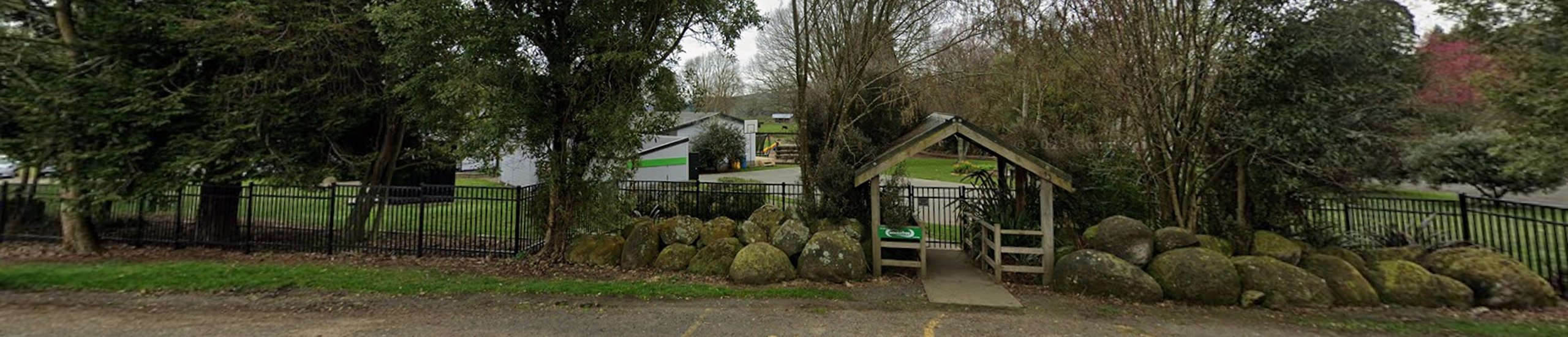
Wharepapa South School offers modern classrooms, including a sensory room, a multipurpose room for cooking, great gardens, and community library.
We plan and work together, ensuring our students have consistent routines and expectations. Children work between the spaces allowing for specialised teaching opportunities that meet the individual needs of all students.
Our curriculum combines the key competencies and values within the context 'Building Happy Successful Learners'. This is reflected in our teaching spaces and learning environments.
As you enter our learning spaces you will see a variety of student work showing new learning and pride in accomplishments. Our rooms belong to our students. They are a reflection of the work they do and the pride they place in learning at Wharepapa South School.
He Whakataukī
Ko te manu e kai ana i te miro, nōna te ngahere; ko te manu e kai ana i te mātauranga, nōna te ao.
(The bird that feeds on the miro has the forest; the bird that feeds on knowledge has the world.)
Literacy is about reading, writing, speaking, listening, viewing and presenting. It gives our tamariki the tools to learn, to express themselves, and to connect with others. At Wharepapa South School, we also value a Māori lens on literacy – recognising that language is about whakapapa (our connections to people and place), ako (learning alongside each other), and whanaungatanga (building strong relationships).
The refreshed English Curriculum is organised into phases of learning, which describe the pathway tamariki take as they progress in reading and writing. At our school, which goes from Year 1 to Year 8, we focus on the first three phases:
We use the iDeaL Approach and Structured Literacy to ensure every child has a strong foundation. This means our teaching is:
We use the Lexia - Core 5 and Lexia - Power Up to help reinforce what students are learning through their explicit reading and structured literacy lessons. Lexia is a gamified version for individual students to complete follow up activities either at school or at home in order to reinforce and solidify their progress.
We want every child to leave Wharepapa South School as a confident communicator – someone who can understand the world around them and use their voice to influence it. Literacy is about more than skills; it’s about identity, belonging and connection.
He Whakataukī
Kei hopu tōu ringa ki te aka tāepa, engari kia mau ki te aka matua.
(Do not grasp the loose vine, hold fast to the main vine.)
This whakataukī reminds us to hold firmly to the important knowledge and skills that will support us throughout life. Mathematics and statistics are part of that main vine.
These two disciplines are closely related but involve different ways of thinking and solving problems. Together, they give students powerful tools for investigating, interpreting, explaining, and making sense of the world.
Mathematicians and statisticians use symbols, diagrams, graphs, and models to find and communicate patterns. These models can describe both real-life and imagined situations drawn from cultural, social, scientific, technological, environmental and economic contexts.
We believe all tamariki can be successful in mathematics and statistics. At our kura, maths learning is:
These programmes work alongside the Refreshed New Zealand Curriculum, which is now organised into phases of learning rather than year levels. At Wharepapa South School we focus on:
We want our tamariki to become curious, confident problem-solvers who can use mathematics and statistics to make sense of the world. Through structured programmes like Numicon and Oxford Maths, and through a Māori world view that values patterns and relationships, we help every learner hold fast to the aka matua — the strong vine of knowledge that will carry them forward.
He Whakataukī
Ko te reo te mauri o te mana Māori.
(The language is the life force of Māori identity.)
At Wharepapa South School, we see language as more than communication — it is identity, belonging, and connection. Te reo Māori me ōna tikanga are an everyday part of our kura, and all tamariki are supported to use and value te reo as a taonga.
Te reo Māori is not just a subject we teach — it is woven into the rhythm of our day. Examples include:
Through these practices, tamariki experience te ao Māori as a living culture, not something separate from their learning.
While te reo Māori is our priority as tangata whenua, students are also encouraged to value other languages. We celebrate the diversity of languages spoken by whānau in our community, and tamariki learn that every language is a doorway to new ways of thinking.
The refreshed curriculum for Learning Languages emphasises:
At Wharepapa South School:
We want every child at Wharepapa South School to value te reo Māori as a taonga and to leave our kura as confident communicators in both English and te reo Māori. By celebrating language and culture, we help our tamariki to grow as proud, connected, and culturally aware citizens.
He Whakataukī
Whatungarongaro te tangata toitū te whenua.
(People come and go, but the land remains.)
Science at Wharepapa South School is about exploring the natural and physical world, asking questions, testing ideas, and using evidence to explain. It is also about our role as kaitiaki (guardians) to protect the whenua, wai, and taiao for future generations.
Science learning is structured around the Nature of Science strand (the unifying strand) and four contextual strands.
Students learn what science is, how scientists work, and how they can think and act like scientists themselves. They:
Students explore living things and how they interact with each other and their environment. At our kura this includes:
Students study Earth’s systems, the solar system, and cycles of change. At Wharepapa South this looks like:
Students explore physical entities such as light, sound, heat, force, and motion. Examples include:
Students learn about matter and its changes (chemistry). They explore:
The refreshed science curriculum is organised into phases:
Our science teaching is:
We want every child at Wharepapa South School to see themselves as a scientist and a kaitiaki — someone who is curious, confident, and capable of understanding and caring for the world around them.
He Whakataukī
He aha te mea nui o te ao? He tangata, he tangata, he tangata.
(What is the most important thing in the world? It is people, it is people, it is people.)
The Social Sciences help us understand people, places, cultures, and histories. They give tamariki the tools to explore the past, make sense of the present, and prepare for the future.
In the refreshed New Zealand Curriculum, the Social Sciences are about:
Through the Social Sciences, students learn to ask questions, think critically, and take action in their communities.
From 2023, the teaching of Aotearoa New Zealand’s histories is part of the Social Sciences for every kura. At Wharepapa South School, this means tamariki learn about:
We weave together te ao Māori perspectives and Pākehā perspectives so tamariki see the many stories that make up Aotearoa’s past.
The refreshed Social Sciences curriculum is organised into phases:
Our Social Sciences learning is:
We want every child at Wharepapa South School to understand who they are, where they come from, and how they can contribute to shaping the future. By exploring Aotearoa New Zealand Histories and the Social Sciences, our tamariki develop the skills to be informed, thoughtful, and active citizens — proud of their identity and respectful of the many stories that make up our nation.
He Whakataukī
Ko te toi whakairo, ka whāia te mana Māori.
Ko te toi o te kupu, ka whāia te mana o te tangata.
(The art of carving gives rise to Māori identity; the art of language gives rise to human dignity.)
The Arts help us to explore who we are, express our ideas, and connect with others. Through the arts, tamariki learn to communicate in creative ways, celebrate culture, and make sense of the world around them.
The Arts learning area has four strands:
The Arts are not just subjects — they are languages for expressing identity, culture, and creativity.
At our kura, tamariki experience the arts in many different ways:
The refreshed curriculum uses phases of learning. At Wharepapa South School, these look like:
Our approach to the arts is:
We want every child at Wharepapa South School to see themselves as an artist, performer, and creator. The Arts give tamariki the confidence to express their ideas, the skills to collaborate with others, and the creativity to shape their futures.
He Whakataukī
Ko te manu e kai ana i te miro, nōna te ngahere; ko te manu e kai ana i te mātauranga, nōna te ao.
(The bird that feeds on the miro has the forest; the bird that feeds on knowledge has the world.)
In today’s world, knowledge and technology open doors. Digital technologies help our tamariki to learn, create, and connect — safely and responsibly.
In the refreshed New Zealand Curriculum, Digital Technology is about learning how to:
It’s not just about using devices — it’s about problem-solving, creativity, and critical thinking.
At Wharepapa South School, digital technology is hands-on, creative, and purposeful:
At Wharepapa South School, we focus on:
We want every student to leave Wharepapa South School as a confident and responsible digital citizen — someone who can use technology to learn, create, communicate, and stay safe online. Digital technologies give tamariki the tools to shape their future and contribute positively to the world.
He Whakataukī
Mauri tū, mauri ora; mauri noho, mauri mate.
(An active soul is a healthy soul; a passive soul is an unwell soul.)
Health and Physical Education is about looking after our bodies, our minds, and our relationships. At Wharepapa South School we value hauora (wellbeing) and the balance between taha tinana (physical), taha hinengaro (mental/emotional), taha whānau (social), and taha wairua (spiritual).
In the New Zealand Curriculum, Health and Physical Education focuses on:
Through Health & PE, tamariki develop the knowledge and skills to live balanced, active, and healthy lives.
At Wharepapa South School, we:
We want every child to leave Wharepapa South School as a confident, active learner who values hauora and enjoys movement. Health and PE are about more than sport — they are about building the resilience, skills, and attitudes that help our tamariki to thrive in all areas of life.
Our classrooms are connected with double doors that are often opened up to combine learning experiences and provide tuakana taina opportunities for our students. We cater to students from Year 0 to year 8 by switching between a collaborative space for morning hui, singing and assemblies, and closing the double doors to split into more targeted learning for the students.
We provide a variety of furniture options and spaces for our students so they are able to learn in an environment that best suits their individual needs. Our children are able to work within small mixed ability, mixed age groups. We work on the premise of stage not age.
Our teaching and learning philosophy is to celebrate individual and collective success.
This is a fantastic space that is used for a variety of activities including assemblies, science experiments and music lessons.
It also includes an impressive kitchen for students to prepare, cook, and eat kai grown from our mara kai (vegetable garden) as part of the Garden to Table program.
For a small school we have a fantastic library that we share with our community. Anyone from the community is welcome to come and borrow books that have been donated from local families.
We have a great music space set up in our library where students are able to try their hand at piano, ukulele and a range of other instruments. We are very lucky to be able to offer 1-1 piano lessons to our students on a weekly basis!
Preschoolers are welcome to visit, enrol and borrow books.
We have an excellent range of picture books to help spark a love for literacy. There is also a playgroup held in the library every Wednesday from 10:30am - 12:30pm. You can check out their Facebook Page HERE or just pop down for a visit to meet Aleisha (Playgroup Coordinator) and the other playgroup parents.
At Wharepapa South School we are incredibly fortunate to enjoy wide open spaces that encourage play, exploration, and adventure.
Our sealed court is a hub of activity, perfect for basketball, rollerblading, and skateboarding. During the warmer months, our swimming pool is open and well-loved by students.
The large sandpit is always popular — complete with rocks, plenty of space, and water hoses to inspire creative play. Our bike track is another favourite, with small jumps and berms to challenge riders. A range of high-quality bikes and helmets are provided so everyone can get involved safely.
We have two playgrounds: one designed especially for our younger tamariki as they build confidence and physical skills, and another for our senior students. The senior playground is currently being redesigned by the students themselves, ensuring it will continue to challenge and inspire while remaining welcoming for the whole community, including visiting campers.
Alongside the playgrounds, our grounds feature a zipline, wide open fields, native trees, and natural rock features — the perfect setting for outdoor adventures, imaginative play, and simply relaxing with friends.
At Wharepapa South School we know that learning doesn’t just happen in the classroom – it can happen anywhere. When tamariki are learning online, it’s important that they have fun, stay safe, and continue to grow their skills across different learning areas. Below are some trusted resources we recommend for whānau.
Before jumping into online learning, please remember:
Netsafe Aotearoa has excellent advice for whānau about cyber safety: www.netsafe.org.nz
Twinkl – Packed with resources across all learning areas. They have opened up free access for parents.
Te Reo Singalong at Home – Daily videos from Sharon Holt, one of our favourite authors.
Kōrero Māori at Home – Try using simple phrases with your tamariki:
Reading Eggs – 30-day free trial, interactive reading activities.
Epic – A free site where parents can sign up for thousands of books.
Sunshine Online – Great for juniors, with books, letters and word activities. (Free 14-day trial, full access coming soon).
Ready to Read – The same books we use in class. Some will be familiar to your child. (Thanks to Dyer Street School for this list!).
Oxford Maths - We use Oxford Maths as a tool to ensure coverage at the correct level for your child. Students also each have a login to access what they have been learning at school, from home.
Prodigy Game – A fun maths adventure game.
Free Maths Packs – Downloadable packs by year level:
Safe and kid-friendly shows:
Kiri & Lou – Gentle 5-minute videos with music and values.
Goodnight Kiwi – Celebrities (including Jacinda Ardern!) reading NZ picture books.
Horrible Histories – Funny but accurate history stories.
Junk Rescue – Creativity with recycling.
Kitchen Science – Dr Michelle Dickinson (Nanogirl) shows fun home science experiments.
Speak Māori for Kids – Practice reo in fun ways.
⚠️ Remember: YouTube must always be supervised. Use YouTube Kids if possible.
Cosmic Kids Yoga – Yoga and mindfulness activities.
Storyline Online – Celebrities reading picture books aloud.
Go Noodle! – Movement and songs tamariki will recognise from school.
Learning online can be busy. Balance is important. Try mindfulness playlists like For Our Children. Encourage your child to spend time outside, play sport, or help in the garden.
Use te reo Māori calming prompts:
✨ Most importantly – Learning at home should be enjoyable. Mix online activities with reading together, playing outside, cooking, or talking about the world around you. In our busy lives, ko te mea nui – your time is the greatest gift you can give your tamaiti.

At Wharepapa South School, we believe the very best thing you can do for your child’s learning is to spend time with them. You are their first teacher, and the everyday moments you share together make a huge difference.
Home learning doesn’t always have to look like traditional homework — it can be found in the conversations, games, and experiences you create together. Some simple but powerful ways to support your child’s learning at home include:
Homework is designed to support what your child is learning at school. Its main purpose is to practice skills already taught, or to gather information for class. Homework may include spelling, reading, or basic facts. Click on the below links to see what else you could be doing to support your child with their learning.
Our goal is to equip children with the confidence and skills to access their school learning anywhere, anytime. With the support of digital tools, we encourage students to become independent learners and researchers — preparing them for a future where learning doesn’t stop at the classroom door.
Parents, please support our local businesses




Visit Website

Call Direct

Send Email
Visit Website
Call Direct
Send Email
Visit Website
Call Direct
Send Email
Visit Website